.png)


Concept Note
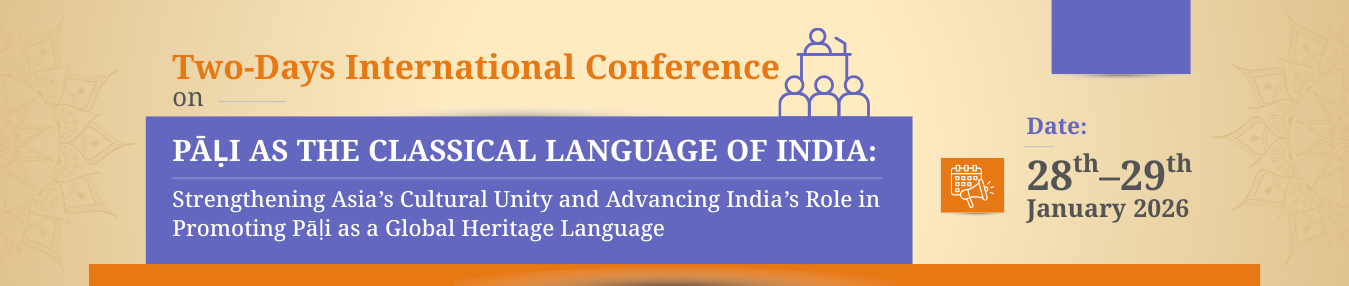
Recognized by the Government of India as one of the Classical Languages, Pāl̥i stands as the foundation of Buddhist studies and a testament to India’s rich intellectual heritage. Its influence extends beyond religion and philosophy into diverse disciplines such as psychology, neuroscience, medicine, law, economics, ecology and human rights, making it a living tradition that continues to engage with modern academic and scientific thought.
As the language of the Theravāda Tipiṭaka, Pāḷi serves as a bridge between India and Asia’s shared spiritual and philosophical legacy, reflecting universal values of compassion, equality, and wisdom. Its enduring relevance lies in its ability to inspire ethical reflection and promote intercultural understanding across disciplines.
This conference seeks to explore the interdisciplinary and comparative dimensions of Pāl̥i, encouraging scholars from varied academic backgrounds to engage with its texts and ideas. Aligned with the National Education Policy (NEP-2020), it supports India’s mission to promote Cultural Diplomacy and preserve the Indian Knowledge System (IKS) through collaborative and global scholarship.
Expected Outcomes
- Deeper understanding of Pāl̥i’s relevance in modern research and education.
- Strengthened academic collaboration in Buddhist and Pāl̥i Studies.
- New interdisciplinary research insights and approaches.
- Promotion of intercultural dialogue among Asian scholars.
- Support for NEP–2020 and Indian Knowledge System initiatives.
Sub-Themes
· Interdisciplinary Dimensions of Pāl̥i Language and Literature
· Pāl̥i and Buddhist Psychology: Mind and Consciousness
· Healing Science in Pāl̥i Literature: Medical and Therapeutic Insights
· Law, Justice and Governance in the Pāl̥i Canon
· Economic Ideas in Pāl̥i Texts and Their Modern Relevance
· Ecological and Environmental Thought in Pāl̥i Literature
· Pāl̥i and the Social Sciences: Society, Culture and Human Development
· Comparative Philosophy: Pāl̥i and Contemporary Discourses
· Pāl̥i as a Medium of Cultural and Civilizational Dialogue in Asia
· Pāl̥i and the Indian Knowledge System (IKS)
· Contemporary Relevance of Pāl̥i Studies in NEP–2020
· Digital Preservation and Research in Pāl̥i and Buddhist Studies
· Innovations in Teaching Pāl̥i and Buddhist Philosophy
· Globalization of Pāl̥i Studies and India’s Cultural Diplomacy
· Peace, Compassion and Human Development through Pāl̥i Wisdom
· Modern Relevance of the Pāl̥i Canon
· Buddhist Psychology and Abhidhamma through Pāl̥i Literature
· Translation Challenges in Pāl̥i: Tradition and Modernity
· Pāl̥i Commentarial Literature: Heritage and Interpretation
· Digital Humanities and Their Role in Pāl̥i Studies
· Women in Pāl̥i Literature and Buddhist Thought
· Comparative Study of Pāl̥i with Sanskrit and Prakrit
· Preservation of Manuscripts and Rare Pāl̥i Texts
· Pāl̥i and the Spread of Theravāda Buddhism